Sunday, March 13, 2011
Talat Kok Pho
There it was in black and white in the “Vientiane Times”, Lao’s English language newspaper, the city’s largest market “Thong Khan Kham” was to be torn down and relocated into what is currently a swamp outside of town. This seemed pretty nuts given that most first world cities are trying their damndest to re-open fresh markets in their centres.
Last year the towns second biggest market, “That Luang” accidentally burned down and is now the construction site of a proposed low rise tower of luxury condos being built by the Vietnamese. Those market stands have now also been relocated to the outskirts of town.
The really crazy part about all this is that there isn’t any alternative to local market shopping. It’s not like you can go to Wal-Mart or Tesco to get your fresh veggies, meat and noodles. They just don’t exist here with no indication that they’ll be built in the foreseeable future.
Going to my market, Talat Kok Pho Tavisup, which is just steps away from the “treehouse”, is one of the highlights of my day but with all this dire news trickling in I thought it was time to document the people and the place. So I resolved to interview the women and men of my market. I called my friend Pa – who speaks English – and asked her to come and help me translate. Here they are.
This is Joy. Her stall has local vegetables but also Thai imports like asparagus and sugar snap peas. Actually, her name isn’t Joy, that’s her nickname. The Lao believe that when a baby is born you have to wait at least a month before you give the kid a name because mischievous spirits known as “phi” can enter the child through their name. So everyone gets a nickname which is what everyone ends up being called for life. Joy means skinny and can be used for a boy or a girl.
Joy is 43 years old and has two children. She’s originally from a town about four hours drive from here. Vang Vien. I asked her if she was happy with her job and she said she was indeed very happy and loved her job. Because I’m a preferred customer, a purchaser of asparagus and sugar snap peas, Joy always throws extra goodies in my bag, like a couple of limes or a bunch of scallions.
This is Noy. Noy means little. She is 35 years old and single. In Laos it is not considered strange to ask people how old they are. In fact it’s important information to have about a person because it impacts on how they should be addressed both in tone and grammar. She is a Vientiane native and gets her produce from a wholesale market downtown which I didn’t even know existed. Have to check that out.
This is Nang Kham. She is 28 and moved from Xieng Khuan in the north ten years ago. She has one daughter. Her stall sells salt, sauces, canned goods, dried beans, and other odd items like cigarette lighters. When I gave her a copy of this photo she made a seriously deep bow (known as a “nop”).
This is Song Pon. She is 40 and has two sons and one daughter. The absolutely very first question you get asked by a Lao is “How many children do you have?” It’s the Lao equivalent of “So, what do you do?”. She is originally from the northern state of Xainabouli. I like her stall because she tends to have different - often foraged - items for sale. She told me she pays 26,000 kip rent per day for her indoor stall. That’s just over three dollars. I know it sounds cheap but when a bunch of coriander goes for 10 cents and a couple of cucumbers cost a quarter it doesn’t sound like such a bargain.
Here’s Sia. He’s 24 and speaks very good English -- showing that an education doesn’t necessarily get you a job in a suit. He grills tilapia to go. The fish come from a fish farm about 30 kilometres up the Mekong river and are brought in each day and kept alive in tanks. Then they’re caked in salt and grilled to perfection. You take it home, remove the salty skin, and eat the flesh wrapped up in lettuce leaves with other goodies, like lemongrass and chili. He’ll sell you a packet of these add ons all sliced up as well.
This is Kwai. It means buffalo which is what we call him. Here he is with his daughter, Panda. He is our local pharmacist and speaks excellent English. We love Lao pharmacies because you can get whatever you want over the counter - no prescription necessary. When Bruce and I had dengue fever recently we survived on paracetemol with the kick of ample codeine purchased from Buffalo.
On a Friday night both Buffalo and the women of the market let their hair down with a few bottles of Beer Lao. I always demur when they offer me a glass but Bruce knocks a couple back with Buffalo and the boys. You have to be polite after all.
Thursday, December 16, 2010
Somsanga
Before I left for Italy this summer, a small band of Women’s International Group (WIG) ladies had a meeting with the United Nation’s Office of Drugs and Crime (UNODC) about a pilot project to help the women of Somsanga, Laos’s largest drug rehab center situated a few miles outside of Vientiane. UNODC already had vocational training programs in place for the men – t-shirt printing, carpentry shops, etc. but nothing for the women.
Stefan, the German coordinator, explained that the most successful programs were ones where the women could learn some skill that might translate into a job when they got out plus generate income for them while inside. We resolved to put our heads together and come up with a plan.
By the time I got back from Italy the plan was in high gear. Tomato and Onion Relish was going to be made at Somsanga, bottled and the sold at the annual WIG Bazaar in November. A gang of eight WIG women had signed up and had already narrowed down the recipe to two choices. One of the first things I did on getting back to Vientiane was to go to a dinner where we ate hot dogs and hamburgers with both relishes to decide which one we wanted to make.
Here’s the winning recipe:
Tomato Onion Relish
Ingredients:
- 4 kilos ripe tomatoes
- 1.5 kilos brown onions
- ½ cup of salt
- 1 litre of white vinegar
- ¾ cup of sugar
- 3 Tablespoons of curry powder
- ¾ teaspoon cayenne pepper
- 4 ½ teaspoons mustard powder
- Freshly ground black pepper
- 1 tablespoon cornstarch (optional)
- Method:
- Place tomatoes in boiling water briefly and then remove skins
- Remove core and chop into small chunks
- Peel and dice onions
- Place together in a bowl and sprinkle with salt
- Leave overnight in a cool place
- The following day, drain off liquid and discard.
- Place tomatoes and onions in a large saucepan.
- Add vinegar
- Slowly bring to a boil and then lower heat and simmer for ½ hour stirring occasionally
- Add sugar, curry powder, mustard powder, and cayenne.
- Add black pepper to taste
- Simmer for approximately 30 more minutes
- If the relish seems too watery, thicken with cornstarch mixed with cold water. Add slowly while stirring continuously
- Place relish in warm sterilised jars
- Cover and seal
Seems pretty straightforward, right? Oh, no, no, no dear reader, not at all.

First of all we never should have picked a recipe that begins “The day before...” because we were only at Somsanga one day a week. So we were either chopping everything as you see here at the center or we were chopping at a WIG member’s house and hauling it up there. Even going two days in a row was problematic since “Leave overnight in a cool place” was initially impossible because Somsanga had no fridge. (Later a fridge was available). So we had to schlepp it back to Vientiane and store it in someone’s fridge overnight. And we weren’t just making the amount in the recipe, we were tripling or quadrupling it.
Other trip-ups were the fact that Somsanga doesn’t really have a proper kitchen. No running water inside and just two gas burners to cook and sterilize jars on.
The WIG ladies did all the purchasing of supplies but not as a donation, part of the project was to explain how a small cottage business works. Here’s our presentation explaining the costs of ingredients, jars and labels per jar and how much profit we hoped they would make after they paid us back IF we could bottle and sell 200 jars. No, none of us could actually write this by ourselves, the center gave us two interpreters to translate and they wrote this up. Capitalism at work.Because there wasn’t enough work for everyone when we were cooking and bottling the relish, we brought art supplies up and had the women and girls design the label. This was done in the “recreation” room which is basically an empty space with a ceiling mounted television and a great big Buddha. We put all the designs up on the wall and then they voted for their favorite. Democracy at work.

One week we left a lot of shiny foil paper behind and when we came back they’d transformed them into amazingly intricate mobiles that they decorated their rooms with. Lao women’s small motor skills are phenomenal which is why they’re such great weavers.
In the middle of all this I got my monthly e-mail from George Soros’s Open Society Institute pillorying the governments of Thailand, Cambodia and Laos for their drug rehab programs as illegal forced incarceration without trial. This gave me pause. Yes, it’s true the rehab center is really a prison, in fact the building was originally a “re-education camp” after the revolution. It had been run by the military but was now under the auspices of the Mayor of Vientiane – a definite improvement. Women end up in Somsanga most of the time because either their families or their village chief drop them off. They remain there until someone in charge decides they can be let go – minimum stay six months.
Most of the drug abuse in Laos is methamphetamines. An ethnic group in northern Myanmar (Burma), the Shan, manufacture it to finance their war with the military junta. They want their own state. Much of the product is headed for more populated countries like Thailand and Vietnam but it gets couriered through Laos. The sad part is that often times women end up hooked without having a clue what they’re taking. They think of it as an energy pill enabling them to work extra shifts at a garment factory or stay up all night studying. But Red Bull it ain’t.
In the end, I decided that going to Somsanga and, hopefully, making a tiny difference and bearing witness to what the place was like was better than staying atop my high horse and rejecting it. What do you think?
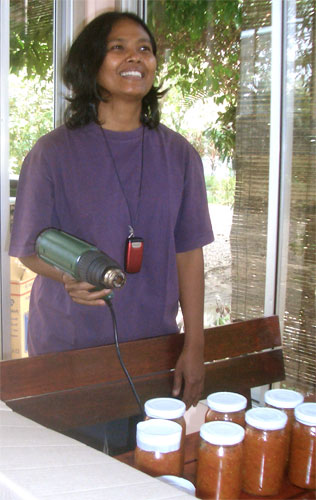
This is Nongnut Foppes, originally from Thailand she married a Dutch man and lived in Holland for a few years. When they moved to Vientiane she missed yoghurt so much she started a small business supplying us “falang” with what I have to say is the best yoghurt I’ve ever eaten. Her passion fruit yoghurt is sublime. She sold us the jars and when they were filled we brought them back to her and she showed us how to seal them with a hot gun. Here at last is the finished product with label and seal.
And here is the Somsanga booth at the WIG Bazaar. The guy is a German volunteer and the women in the picture are from the center and were allowed to come down for the day to sell it. I had pushed for the woman standing to be allowed to do this since she was one the hardest working women on the project.
We’ve not yet sold all 200 jars but we made back our costs with money to spare and I believe in the end we’ll sell the whole lot. We asked Stefan how the profit would be divided. He said in the past they’ve given the participants a choice. The money can be held for when they get out. Or they can use it to improve their diet while inside. Or they can pay to have a party. And naturally, being Lao, they always pick a party. Maybe that’s why I’m here.
Sunday, November 28, 2010
The Return
Just days before leaving Laos for a summer back in Italy two things happened to make my return to Vientiane in September something I could really look forward to. The first was a new place to live. A house on stilts on the banks of the Mekong in the middle of a coconut grove. We call it “The Treehouse”. Almost as exciting as the view was the fact that a traditional Lao market was steps away. The second was being invited to become co-chair of the Cultural Study Group an offshoot of Women’s International Group – an organization of ladies who do good works. Cultural Study Group organizes lectures and presentations for the ex-pat community about Lao culture so foreigners can get to know more about the place they’re living in.
I learned while away that our first presentation would be tied to the launch of a new cookbook “Food from Northern Laos” by Dorothy Culloty with photos by Kees Sprengers. Amazingly, I had already been in touch with Dorothy via my friend in Luang Prabhang, Caroline Gaylard, of the restaurant “Tamarind”. Caroline had told me that Dolly – as she’s known to her friends – had beat her to the punch with a super book on Lao cooking yet to be published. I got in touch with Dolly and she e-mailed me enticing chunks of the book along with her husband Kees’s luscious pictures. So now they’d been published and I was about to meet them, talk food and get my very own copy of the book. How serendipitous was that? http://www.foodfromnorthernlaos.com
Besides talking about Lao food and showing slides from the book, they also prepared a table full of Lao-style hors d’oeuvres for us all to nibble on afterwards. Meanwhile, their “adopted granddaughter”, Khamsouk Philatorm, a young woman from the Khmu ethnic group who had just taken her first plane ride down from the north hauling local ingredients, demonstrated Lao cooking techniques like slicing banana flowers and how to peel rattan. You can eat the core of rattan raw or cooked. Yes, I do mean that stuff you make furniture out of.
I took my autographed copy of “Food from Northern Laos” home and started cooking up a storm. Every recipe was a winner! The book includes not just classic Lao fare like Or Lam and Laap but also dishes from, and information about, the various ethnic groups that live in the north. The Tai Dam or Black Tai came from Vietnam in the nineteenth century and the women are particularly renowned for their weaving. Here’s the recipe for:
Tai Dam Pork Stew
Ingredients
- 4 cups of water
- 1 t salt
- 2 T oil
- 1 stalk lemongrass – trimmed to 10 cm (4 in)
- 2 chilies (or more to taste)
- ½ tsp chicken stock powder
- pinch of salt
- 200 grams (6 oz) thinly sliced pork
- 1/3 cup roasted rice powder
- 1 bunch Chinese flowering greens cut in 5 cm (2 inch) pieces
- 1 bunch dill – two fingers width.
- Put the water and salt in a medium pot and bring to a boil
- Meanwhile, heat a wok or frying pan. Add the oil and when it is hot, stir fry the lemongrass, chilies and sliced pork for a minute. Season with salt and chicken stock powder Fry 1 minute more until the meat changes is color and is lightly cooked.
- Add the meat mixture to the boiling water, reduce heat, and then simmer for five minutes or longer for really tough meat.
- As the meat becomes tender, stir in the ground, roasted rice. Stir constantly, very gently simmer the stew as the rice thickens it (at least 7 minutes).
- Add the Chinese greens. Simmer. Remove the stew from the heat when the vegetable stems are cooked but still crisp (about 3 minutes). Taste and adjust salt.
- Cut the dill into 5 cm (2in) lengths and stir in.
What makes this dish uniquely scrumptious is the roasted rice powder. It gives the stew a nutty flavor. To make it you dry roast rice - either sticky or plain - until it is a deep golden brown and then pound it up in your mortar and pestle or use a coffee grinder. Making this gave me a kind of déjà vu of making gumbo. I always get nervous making the roux. Is it brown enough now? Or not enough? If I don’t take it off now will it suddenly burn and taste bitter? But then I thought, well, it’s only a couple of tablespoons of rice. If you mess it up you can start again.
At the beginning of the book there is an exhaustive listing of Lao ingredients – with photos, the English name (if any), Latin name, Lao name transliterated and Lao name in Lao script. By toting the book to my market ladies round the corner I was able to communicate that I was looking for say, prickly ash berries, Lat. Zanthoxylum rhetsa, Lao mak ken.
These taste a lot like Szechuan peppercorns and may, in fact, be a wild variety, but they seemed more zingy to me. Maybe because they’re fresher. You want to get rid of the little black seeds because they’re bitter. I used them in this recipe from the Tai Lue people.Pork Spicy Salad, Muang Sing Style
Ingredients
- 250 g (1/2 lb) lean pork finely chopped
- ¾ cup carrot chopped into ½ cm (1/4 in) dice
- ½ cup shallot, chopped
- 3 T duck fat or vegetable oil
- 2 T garlic, chopped
- 2 T fish sauce
- ½ - 1 t chicken stock powder
- 1 – 2 t chili pepper, ground
- 1 – 2 t prickly ash berry (mak ken), ground
- 2 – 3 T Vietnamese mint (or a small handful each of small coriander and mint)
- 1 medium green chili, finely chopped (or more to taste)
- Prepare all the chopped ingredients except the herbs.
- Heat a wok. Add the duck fat or oil. When hot, add the chopped garlic followed by the minced pork, fish sauce and instant stock.
- Stir fry for 2 minutes until opaque.
- Toss in the chopped carrot and shallots and swoosh about with a wok spoon or spatula. Sprinkle in the chili pepper and mak ken. Mix. Keep stir frying until the carrot and shallots are lightly cooked and the pork is done. Taste and adjust seasonings if needed.
- Remove the wok from the heat. Finely chop the herbs and mix into dish. Picture of dish.
One of the dishes Dolly, Kees and Khamsouk made for the Cultural Study Group presentation was a dish of the Akha people. Originally from Yunnan, China and Burma they migrated to northern Laos starting in 1850. The women still wear the most beautiful costumes. Here’s a photo taken by Kees.
This recipe for Akha pork balls presented a couple of challenges. One of the ingredients was “a sprig of young guava leaves (optional)”. Not knowing how to say that in Lao, I was about to leave it out when my neighbor, Gwyn, who’s lived in Southeast Asia for many years pointed out that I had two trees in my garden! Here’s my guava leaves with the Mekong in the background.
The other difficulty was locating “1 Tablespoon of pig or duck blood” to use as a binder. Fortunately, Dolly had anticipated this and suggested substituting “1 Tablespoon of egg yolk” which I did. Here’s the recipe.
Akha Pork Balls
Ingredients
- 1 – 1 ½ C minced pork
- 3 cloves garlic, peeled
- ½ t salt
- 1 small green chili (not bird’s eye chili)
- ¾ - 1 t stock powder
- 1 sprig young guava leaves (optional)
- 3 T mint
- 3 T sawtooth herb, finger width cluster chopped
- 3 small spring onions, whites and greens, chopped
- 3 T Vietnamese mint, finger-width bunch, chopped or 3 small coriander plants, stalk and green, chopped (use if no Vietnamese mint)
- 1 T pig or duck blood (substitute 1 tablespoon egg yolk)
- 1 C hot water
- Pound the garlic, chili, salt and instant stock together with a mortar and pestle for a minute. Add the herbs and then pound the mixture together until thoroughly blended. Add the minced pork and pound again for a least five minutes. Pounding breaks down the meat fibers and make for light meat balls which stick together. Taste and add more salt if needed. Add the duck blood or egg yolk and mix together.
- Put the hot water in a small pot. Roll pieces of mixture into 2 cm (3/4 in) balls. Place them in the water as the balls are rolled. This stops the balls from breaking up. Set the pot on the fire, cover and simmer for up to 15 minutes until the meat balls are cooked through. Top up the water if the water levels gets too low and the meat balls start to stick to the pot. Remove from heat and transfer balls to a bowl.
Sawtooth herb was one of the mystery leaves from “Detective Story”. Eryngium foetidum. I find it reminiscent of fresh coriander but more so. I think you could use more fresh coriander instead if you can’t find it.
I found the Vietnamese mint at the market by showing the photo to the woman I buy most of my veggies from. She went around the market yelling (in Lao) “So who here’s got Vietnamese mint” until a bunch was found for me. I love my market and the women in it. But more on that later.
With apologies to Dolly, I always leave out the stock powder she calls for since it’s mostly MSG and it doesn’t agree with me.
There’s so much more I want to try. A dish with dried fermented bamboo shoots. A chili paste with freshwater crab. A smoked fish stew with apple eggplants. Every day I wander past the vendors at the market to see if I can buy some obscure ingredient – water bottle gourd, rattan, fiddlehead ferns, acacia leaves, etc. If I’m lucky I snatch up my find and head back to “The Treehouse”, crack open this definitive tome, and start chopping and pounding my little heart out.
Saturday, June 5, 2010
Strange Fruit
There’s zero cooking involved in this post but I thought you might like to take a look at some of the exotic tropical fruit common here but hard to find elsewhere.
Here’s a Vientiane institution that New York’s health crusading mayor Michael Bloomberg would whole heartedly embrace. It’s the fruit cart guy. Everyday he and others like him wheel unmotorized carts around the neighborhood dinging their little bells to announce their arrival. He sells fruit and things that are closely related to fruit - like corn on the cob - as snacks which Laotians buy, well, literally by the cartload.
He’s also a good barometer of what’s in season since he certainly doesn’t have the capital to invest in high end imported items. All this produce is sold with a little packet of dipping mix made up of chili, salt, sugar and MSG. Today we have watermelon, sour plums, corn and this:
This is the seed pod of the lotus (nelumbo nucifera). The lotus is sacred in Buddhism and represents the beauty of enlightenment rising from the muck of the pond. And it’s all edible, roots, leaves, stems and pods. At first I found these seeds way too bitter to be enjoyable but then I discovered that there’s an outer skin which if peeled off leaves a tasty little morsel. It’s like peeling a fava bean and may be the Lao equivalent of sunflower seeds. Something you fiddle around with while chatting to friends or watching TV.
As I write, rambutan, (nephilium lappaceum) is here in abundance. Aren’t they fabulous looking? You peel off the fuzzy red outside to reveal a litchi like fruit that is better than a litchi. Like a litchi, it has a small pit in the middle of it. The English, rambutan, actually comes from Malay and means hairy. They’re addictive.
This may be my absolute favorite tropical fruit. Mangosteen (garfinia mangostana). Also very much in season right now. You peel off the purplish skin which reveals four or five pure white segments, botanically known as “arils” which have a sweet, evanescent, perfume-like flavor.
This has to win the prize for most gaudy and glamorous in the fruit category. Dragon fruit (hylocereus undatus). Unfortunately, it’s flavor doesn’t quite match up to the visuals. It’s a bit bland with a whole lot of kiwi like little black seeds in it. I once saw it growing in Vietnam and it was amazing. Imagine a tree that looks like a Christmas cactus but instead of an orange flower at the end of the serrated succulent leaves one of these is hanging.
Right after I penned the above words I went on line and found this photo of a dragon fruit plant and guess what? It is a cactus! One which hails from central America. Which seems odd since I’ve never seen it for sale in southern Mexico where it originally comes from. N.B. My pal, Bill Pandolf, who lives in Veracruz, Mexico, wrote that the plant grows wild there and is pollinated by night flying fruit bats. The flower opens at night and dies the next day. He sometimes sees the fruit in springtime in small country markets for just a day or two and then they’re gone.
Obviously these are mangos but the difference in Laos is that people like to eat them green. My landlady, Nang, gave me these which she’d just picked off her tree. The Lao like to use the green mango just like green papaya. Peeled, shredded and tossed with chilies, fish sauce, lime, garlic and a pinch of sugar. But they also eat it as is. Lao find the sour puckery quality thirst quenching.
Pomelo is like a grapefruit on steroids – known appropriately in Latin as citrus maxima - but it’s not as bitter and also not quite as juicy. It has a thicker rind and you definitely have to peel off the membrane around each section because it’s too tough. Bruce, my husband, has really gotten into a fruit salad mix of this and fresh pineapple, along with Chinese pears, watermelon, and topped with banana. Pomelo is also used in Vietnam in cold beef salads although I haven’t encountered that here as of yet.
I first had custard or sugar apples (annona squamosa) in India. The people we were staying with in Mysore had two trees by the front door. As with all fruit, they were so much more delicious straight from the bush than these I bought here in the market. It’s kind of a pain to eat as well - the skin is mealy so you have to gently pry it off and the flesh inside has lots of small pits that you have to keep spitting out as you go along which doesn’t make for very attractive eating.
Here is the infamous, kind of scary looking, durian (durio zibethinus). The durian has an extremely rank odor which grows stronger as its season progresses. Airlines in southeast Asia forbid it being brought into the passenger cabin and Singapore has banned it being transported on the subway. Way too smelly. You either love it or hate it. But I find the fruit - here pre-peeled by the market vendor – to be actually quite tasty.
When I bought this I thought I was getting a kind of funky looking fig, but it’s not. It’s mak thong. I have no idea what the English or Latin might be. When I cut it open it was another example of a thick skinned fruit with a litchi-like core. Again, quite sour. It was o.k. but I wouldn’t seek it out.
I saw a big pile of these for sale by the side of the road . I haven’t seen them in the market. They’re the fruit of a type of palm tree so perhaps that makes them more of a nut, although the Lao name is mak than and mak is the Lao language classifier for all things fruit. The woman who sold them had to give them a considerable number of machete whacks to get them open.
Here’s the outside and inside. After busting open the fruit/nut you retrieve this white oval lozenge which itself has to be peeled. I have to say that as glamorous as all this seemed the flavor was practically non-existent and certainly not worth the effort. I’m sticking with mangos and pineapple and those wonderful mangosteen.
Sunday, May 23, 2010
Jennifer & Another Thing from Mr. Sing
I opened my email the other day and was thrilled to find a letter from Jennifer Davidson. Ms. Davidson is the daughter of Alan Davidson and the co-editor of “Traditional Recipes of Laos” by Phia Sing the royal chef whose recipes I tried to recreate in my last blog. Getting a letter from Ms. Davidson felt somewhat akin to receiving an answer from a message in a bottle thrown into the Mekong. I had contacted by email the publishers of the cookbook, Prospect Books, and they, very sweetly, gave me her home address in Switzerland. There’s no mail delivery pickup system in Laos, so I wrote a letter and took it to the central post office, bought a stamp and handed it over. You just never know, right? I wanted her to know how much I appreciated her and her father’s work and secretly hoped she would look at my blog and enjoy it. Which given her enthusiastic response I felt she had.
But it seems I had made a terrible mistake. The picture I downloaded from Google Images of Alan Davidson wasn’t Alan Davidson at all. It was another guy, Andrew Graham-Dixon, the TV presenter and art historian who produced a documentary on Davidson. Jennifer very generously took the time to copy and send me three photos of the real Alan Davidson. They’re all great but I like this black and white one the best - it feels as though it comes from another time. Just like Laos.
One of the great benefits of living in another country for a while is getting to appreciate the seasonality of food. Here in Laos we have two seasons, wet & dry. Wet runs more or less from the end of May to the end of September so thus far I’ve really only experienced the dry season. But it’s beginning to rain intermittently and subsequently bamboo shoots of all shapes and sizes are showing up in the market. The Mekong is already full enough that barges can navigate it. Therefore I knew I only had a short time left to sample a great Lao delicacy - mawk khai - ant eggs - only available in the dry season.
Red weaver ants build their nests high up in mango trees. The nest is a complex structure of twigs, bark and leaves and people harvest them in the wild by knocking them down with a long pole into a bucket of water. The eggs sink to the bottom and the ants who, needless to say go crazy, drown in the water. At least that’s the plan. Some usually escape to sting the forager - although it’s not an excruciating pain – but it does go a long way to explain why the price for a handful or so is quite expensive by Lao standards.
I knew mine were fresh because there will still a few struggling ants clinging to life in the batch I bought at the market. My housekeeper, Leh, showed me how to clean them by rinsing and soaking them and getting out the bits and pieces of leaf and twig along with the weaver ant carcasses.
It was then that I started to get cold feet. What, you exclaim, the woman who ate steamed wasp larvae and fried bamboo caterpillars?! But yup this picture was starting to creep me out. First I tried pretending to myself it was picked over blue fin crab meat. But that didn’t work – it really does look like larvae, doesn’t it? Finally I pulled myself together. You eat fish eggs, don’t you? You pay big bucks for caviar and lap it up. Come on, give it a go.
But how to prepare them? I have a recipe for ant egg soup from Natacha Du Pont De Bie’s book “Ant Egg Soup” but it seemed that fish was the primary flavor in that dish and I really wanted to taste the ant eggs. So back to Phia Sing who has a recipe for ant eggs steamed in banana leaves. A mixture of ant eggs, finely pounded pork with shallots, beaten chicken egg and chopped scallion leaves gets wrapped in the ubiquitous banana leaf and steamed. This worked out o.k. but I felt the pork was getting in the way of appreciating the ant egg flavor which seemed slightly sour.
Bruce, my husband, had the brilliant idea to leave out the pork and make a kind of soufflé, separating the chicken eggs, beating the whites to stiff peaks and folding in the yolks mixed with ant eggs, scallion leaves and pounded shallot. Here’s the fluffy pre-steamed mass.
This was the delicious result, and the analogy to caviar is not far off. You know how when you get really fresh caviar the individual eggs seem to pop in your mouth? It’s the same with ant eggs which, by the way, are also very nutritious, containing multiple B vitamins and lots of trace minerals. And they have indeed a slightly sour tang to them which is a feature of Lao food. The Lao have a hankering for sour things which they find refreshing, and bitter things which they believe are good for your health. Sour I can handle but bitter reminds me of my Italian friend’s reply to my query about her three spoons of sugar in one demi-tasse of coffee. “JoJo, life is bitter enough”.
Monday, April 19, 2010
Cooking with Mr. Sing
I really only have one Lao cookbook. “Traditional Recipes of Laos” the collection of Phia Sing the royal chef from Luang Prabhang edited by Alan and Jennifer Davidson. So I resolved to hone my home cooking skills by recreating recipes from the book. My first idea was to go through the book and cook everything in it. But even weeding out those with ingredients that seemed too hard to get even in Laos – “pickled fish roe membrane” or “dried quail (matured until almost moldy)” – there were still over 100 recipes to try.
I decided to narrow the field to recipes that would epitomize different cooking methods and techniques and see what I could learn from that. Here goes.
Recipe #10 Sousi Pa Gnon – A ‘Hot’ Dish of Small Catfish

The second ingredient is written as follows “1 fully grown coconut, split open – grate the meat and squeeze two extractions of coconut milk from it”. This is the kind of instruction that makes me want to turn the page. Have you ever actually split open and grated the meat of a coconut? It’s hard and it takes forever. But here in Laos there is a magic machine that leads you to read on. Click here to see it at work. http://www.youtube.com/watch?v=dsSnBtqG8xA
Then all you have to do is pick out the bigger brown shell bits; add some lukewarm water and squeeze away until you get a nice thick milk – actually more like a cream. You drain and reserve that and re-squeeze the coconut with more water until you get the second extraction. A bonus is that your hands get all soft and lovely from the coconut oil.
I couldn’t understand Mr. Sing’s initial instruction: “Put the first extraction of coconut in a wok on the fire until it becomes creamy”. I mean, isn’t it creamy already? But the next phase of the recipe is to fry a pounded mixture of shallots and chili peppers in it. I realized that I had to reduce the coconut cream, getting rid of its water, until all that was left was the oil as a frying medium. Cool.
So I did that, and then added the fish, the second extraction of coconut milk some kaffir lime leaves; salt and fish sauce. Here it is with a handful of coriander and scallions on top.
Recipe #18 Keng Som Kalampi – Sour Cabbage Soup
Recipe #64 Jeow Bong – Bong Sauce
For a royal cookbook #18 is a very homespun recipe. Pork bones; cabbage; scallions; lemon grass and two fresh tomatoes all boiled up in water until the veggies are cooked. The reason I made it is because it’s supposed to be served with jeow bong. Remember the water buffalo skin being grilled in the fire in the jeow blog? That’s part of recipe #64. The rest of 64’s ingredients include 10 dried chili peppers grilled until brittle; 5 small shallots and 5 small heads of garlic blackened in the fire; 2 slices of galingale. Once these are all pounded together to a paste you stir in the previously grilled and then salt-water-soaked buffalo skin bits. Bruce, my husband, felt that the chewy texture of the buffalo skin made the flavors of all the other ingredients stay longer in the mouth. And the punchy flavors of the jeow were balanced by the simplicity of the soup.
Recipe #44 Kanab Pa Gnon – Catfish Grilled in a Banana Leaf
In Laos it seems that everything that isn’t actually grilled over an open flame is grilled in a banana leaf. Here’s a market stand devoted to the sale of nothing but. And don’t try to buy just a couple of leaves – you have to get the whole pack or else they get very huffy.
This recipe mixes small catfish with finely chopped pork belly; pounded lemon grass, chilies, shallots and pork cracklings; plus some scallions and sweet basil leaves. I guess the pork is to add some fat to the dish. You wrap it all in a double layer of banana leaf and grill it. I couldn’t find small catfish so I bought a bigger one and filleted it and cut it up. But I have to admit I really don’t like the flavor of catfish. It’s got a muddy aftertaste that a lot of river fish seem to have. I’ve decided from now on to stick with tilapia which, although a bit boring, nevertheless isn’t a bottom feeder.
Recipe #27 Pa Fok – Minced Fish Cooked in Packets
This was a real winner. Lots of pounding going on but so worth it. Pound together skinless fish fillet (tilapia); shallots; black peppercorns until a really sticky mush. Then stir in some coconut milk and beaten egg plus fresh coriander and some fish sauce. I know these directions are vague but so’s the recipe. Then you spoon the mixture into banana leaves. By the way, in order to make your banana leaf more pliable, you run the shiny side over an open flame to soften it. I learned that in Veracruz, Mexico along with my tamale in a banana leaf folding and toothpick closing technique which came in handy here. Then you take all your banana leaf packets and steam them for a while – like 15/20 minutes. I know, it really is a very vague recipe. But what you get is divine – like a Laotian quenelle.
Recipe 54b Ua No Mai – Stuffed Bamboo Shoots
I got a kind of false start on this one. I found fresh bamboo shoots, already peeled, at the market, brought them home and cooked them. Bamboo shoots are evidently quite bitter and despite cooking them for over half an hour they were still pretty hard to take. I went online and learned that the Japanese cook them using the rice soaking water to dispel the bitterness so I tried that and it seemed to work. But I couldn’t go on to the next step since I had the wrong kind of bamboo – too skinny to stuff.
I needed fatter shoots which could be slashed through the middle making a kind of pocket into which a mixture of minced pork, shallots and scallions gets smushed. Mr. Sing suggested making the slits with a needle but we used a box knife. They probably didn’t have box knives in Luang Prabhang back then. What a pain – this slashing/smushing is the kind of fiddly cooking assembly that I loath. Mr. Sing prescribed wrapping these stuffed shoots in banana leaves, steaming them and then batter frying them but that seemed like overkill. I was, however, a bit afraid that the whole incredibly labor intensive thing would disintegrate in the oil – so I floured them first and then fried them. Mr. Sing would have you fry them in lard but I used vegetable oil . They probably didn’t have vegetable oil in Luang Prabhang back then either. Unfortunately, they turned out to be absolutely scrumptious but if I ever make these for you you’ll know that I really, really love you to pieces.
Subscribe to:
Posts (Atom)